E-Paper



Work to remove collapsed canopy begins at Delhi airport’s Terminal 1
The process will include mechanical demolition to remove the damaged external shed and its metal columns.


New Delhi
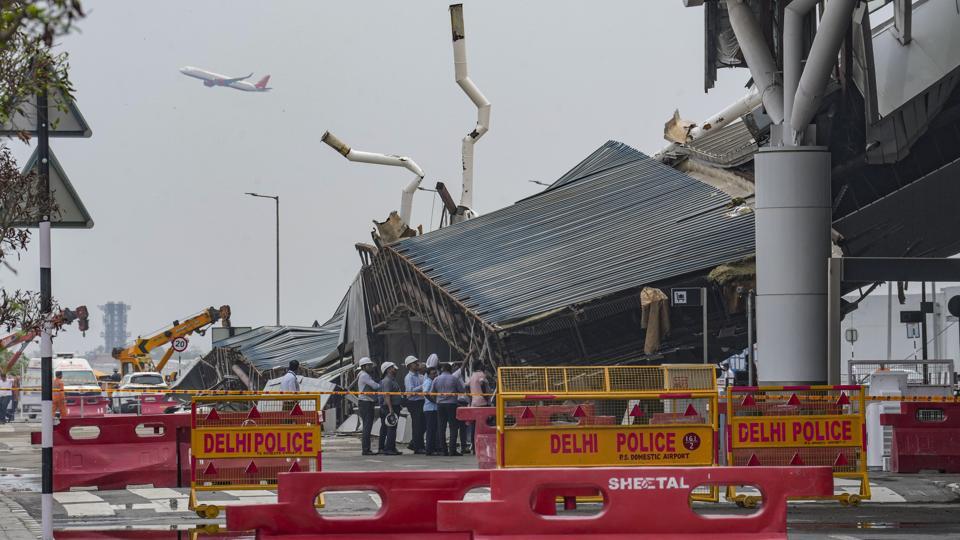
Work to remove the collapsed canopy and debris at Terminal 1 (T1) of Delhi’s Indira Gandhi International (IGI) Airport has begun, and this process is likely to take a few weeks, officials aware of the matter said. The process will include mechanical demolition to remove the damaged external shed and its metal columns, with adequate steps to ensure the entrance facade of T1 does not suffer damage, they said.
A call on the reconstruction of the terminal will only be taken by the authorities after the IIT-Delhi-led technical committee submits its report following a thorough investigation, officials said.
An official, requesting anonymity, said that before initiating the repair work, the damaged external shed, including the canopy and metal columns supporting it, will be dismantled. This includes six main trusses or beams that collapsed on June 28, during a heavy downpour, killing one and injuring at least eight people. Between these beams, there are also three tree columns, two of which were found to be partially broken.
The demolition work started on Monday by Edifice Engineering, the company that was involved in the demolition of the Supertech twin towers in Noida in 2022 and the demolition of a part of the airport terminal before its revamp.
“The trusses support skylight structures made for natural lighting, i.e., the popular white canopy installed outside the terminal and another layer of normal roof sheet structure. All this will have to be demolished,” the official said.
ALSO READ- Delhi excise case: SC notice to ED, CBI on Manish Sisodia’s bail plea
A second official at the airport, requesting anonymity, said: “Work began on Monday. The area was inspected and a little debris was moved too. On Tuesday, more machines were brought in and the process to remove the canopy continued safely.”
Terminal (T1) has not been operational since June 28. Only two airlines, IndiGo and Spicejet, were operating from T1. Both airlines were provided slots at T2 and T3 from June 29, with regular updates being sent by both airlines to passengers about changed flight timings and the new terminal from which the flights will take off or land. This included a change in flight numbers too, in some cases.
ALSO READ- You can now use gift cards to buy Air India tickets. Here's how
T1 was handling up to 200 flight movements per day. SpiceJet’s arrivals and departures are now taking place from T3, and IndiGo’s flights have been divided between T2 and T3.
A new T1 has been built by the GMR-led DIAL as part of Phase 3A of the airport expansion, which brings the old departures terminal T1D and the arrivals hall (T1C) under one roof. The new T1, which is yet to be made functional and is connected to the old T1 building, was yet to be made operational, even after being inaugurated by Prime Minister Narendra Modi in March 2024, alongside 14 other airports. DIAL, then, had said it may take a few months to carry out a series of trials before starting operations.
ALSO READ- HC allows ED to sell 26 luxury cars owned by Sukesh Chandrashekar's wife
Before its closure, T1 had a passenger handling capacity of 20 million, and this would increase to 40 million, once the new T1 becomes operational. T2 can accommodate 15 million passengers and T3, up to 40 million.